
Jean-Baptiste Poquelin (1622-1673) more commonly known as Molière, is a titan of world literature. The French Shakespeare, his influence on the development of early modern theatre, and his acerbic observations on the human condition in his work have fascinated and enthralled audiences for centuries. So great was his lasting influence on French literature that in 2025 Melvyn Bragg would restate the claim that French: ‘…is the language of Molière.’
_-_Google_Art_Project_(cropped).jpg)
Portrait of Molière by Pierre Mignard (c. 1658), public domain, Wikimedia Commons.
Jean Baptiste was born into a well-to-do Parisian family in 1622. Christened ‘Le Nez’ (The Nose) by a maid, it remained a family nickname for the rest of his life. His father purchased the rank of Valet de chambre ordinaire et tapissier du Roi (Upholsterer to the King) in 1631 when the boy was just six. The title provided a steady income and conferred respectability on the upwardly mobile clan. After the death of his mother in 1632, Jean Baptiste was educated at the elite Collège de Clermont run by the Jesuit order (now the Lycée Louis-le-Grand). It is here that the young Parisian got his first taste of the theatre and actors. The Church would never forgive him.
The profession was not held in high regard in Seventeenth-Century France. Actors were publicly shamed as sinners, ran the risk of excommunication, and were forbidden from burial in consecrated ground. It was not the career path for a scion of a respectable bourgeoisie Parisian family. A decree by Louis XIII in 1641 stating that actors were ‘not to be considered worthy of blame nor prejudicial to their reputation’ did little to improve matters, even as the public flocked to theatrical performances. After completing his education, Jean Baptiste initially succeeded his father as Upholsterer to the King and started training as a lawyer. However, at the age of 21, he abandoned a respectable career for a life on the stage. His father and wider family were predictably appalled by the decision.
In 1643, with the actress Madeleine Bejart, he founded the Illustre Théâtre in Paris. It collapsed owing thousands of livres only two years later. The young actor spent a night in debtor’s prison before his despairing father bailed him out. In response, Jean Baptiste took up the name Molière to spare Papa Poquelin’s shame and promptly returned to performing.

Signatures des comédiens de l’Illustre Théâtre sur l’acte de société, 1643. Public domain, Wikimedia Commons.
After the collapse of the Illustre Théâtre into debt and disillusion, the company began a period as itinerant troubadours in the French provinces. The years spent performing around France honed the company’s craft, and Molière’s skill as a writer, but little is recorded of their travels. The lack of detail from this time is manna to an historical author like me, but we do know of important performances for the local estates in Carcassonne in 1651. The plays The Bungler (1655) and The Doctor in Love (1657) were premiered during this period and would make up the company’s repertoire on their return to Paris.
In 1658, after twelve long years dodging creditors and performing throughout France, the company finally returned to the capital. A performance for King Louis XIV in the Louvre was so successful that the company took the name and patronage of Louis’ brother as the ‘Troupe de Monsieur’ and set up home in the Hôtel du Petit-Bourbon. The next fifteen years were mostly filled with success for Molière and his company as the players became the toast of Parisian society.
Royalty on both sides of the English Channel may have feted the new theatres, but the church most certainly did not. Molière’s masterpiece Tartuffe was first performed in 1664 at Versailles, and promptly banned with threats of excommunication to anyone who watched or performed it. Whilst Louis XIV himself seemed unconcerned by the play’s content, the French church authorities were furious at Molière’s jibes at religion.
Molière rewrote Tartuffe, performed it once in 1667, and it was automatically banned from public performance again. Whilst private shows did happen for the nobility, it was not until 1669 that a third version was finally produced for the public. It has remained a staple for the Comedie Francaise since 1680. Arguably, it was only the king’s support that kept Molière from being excommunicated over the play. He was like a seventeenth-century Johnny Rotten (The Sex Pistols) who thrived on the controversies and pushed the boundaries of acceptable society.
His personal life was, to put it mildly, undeniably complicated. A long-lasting and open relationship, friendship, and business partnership with Madeleine Bejart started in the 1640s, and continued for the next three decades. Despite this, Molière married her daughter Armande (1645-1700) in 1662, having three children with her in the 1660s. Armande had travelled with the troupe as a child in the 1640s and 1650s. The master playwright wrote some of his best female parts for his young wife to great success. Madeleine’s opinion on her daughter replacing her on the stage and in Molière’s bedroom is not recorded. Madeleine Bejart died on February 17th 1672, Molière was by all accounts distraught at her passing.
Molière’s final years in Paris, saw the company perform some of his most widely known plays: Tartuffe, The Misanthrope, Don Juan, Love Is the Doctor, Amphitryon were all premiered in the late 1660s and early 1670s. His final play was ironically named the Le Malade Imaginaire (The Hypochondriac). Molière, who had been struggling with tuberculosis for years, coughed up blood as he played the title character but insisted on continuing. After the performance, he was carried home and died that same night. It was the first anniversary of Madeleine Bejart’s death. Church authorities, so often the victims of Molière’s barbs, were unforgiving. Two priests refused to administer the last rites for him and a third could not make it in time.
His widow Armande Bejart personally petitioned Louis XIV that he could be buried in consecrated ground despite his profession as a playwright and actor. Louis agreed and Molière was buried in a cemetery reserved for unbaptised infants. After the French Revolution, his remains were exhumed and moved to the Museum of French Monuments, and moved again for a final time in 1817 to the Père Lachaise Cemetery in Paris. His legacy in France and the wider world was already secure.
Sir Lawrence Olivier was not a fan. When Olivier found out that Hume Cronyn was going to play the lead role in Molière’s play The Miser in 1963, he told Cronyn: ‘Molière? Funny as a baby’s open grave.’ Despite this, the Frenchman’s plays have always been incredibly popular on the English stage. Initially translated into English prose in 1714, and a full translation in 1739, more translations and adaptations of his plays appear regularly. His vicious satires about the human condition remain bitingly relevant to modern audiences. A reimagining of Tartuffe, set in a Nigerian-Jamaican family and incorporating music and spoken word, is currently in production. Written and directed by Darren Raymond and starring Sir Mark Rylance, it is coming to the London stage at the Marylebone Theatre in September 2026.
Molière himself has been widely portrayed in film, books, and plays. My personal favourite is his appearance with the infamous three musketeers in The Vicomte of Bragelonne by Alexander Dumas. Even AI is now getting in on the act. Kim Wilshire writing in The Guardian in May of 2026, reported that researchers at the Sorbonne have used AI to create a play in the style of Molière. L’Astrologue ou les Faux Présages (The Astrologer, or False Omens) debuted in Versailles this year (2026). I do wonder what Molière, a master satirist of the human condition, would think of an artificially intelligent computer writing his words. I suspect he would be both rather amused and viciously spiteful about the whole idea.
‘Molière is to the French what Shakespeare is to the English: the last word in historical literature, drama, wit and satire.’ (Kim Wilshire, Guardian, May 2026)
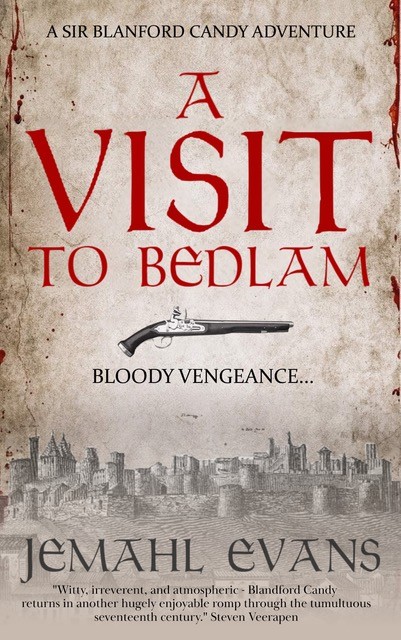
Amazon affiliate link.
JEMAHL EVANS has pursued a lifelong passion for History. Jemahl was educated at Christ College Brecon, St Mary’s University College (Strawberry Hill), and U.W.E. Bristol. His Blandford Candy series of books set during the English Civil War and Restoration have been critically acclaimed and the latest in the series, ‘A Visit to Bedlam’ has just been published. You can visit his website and follow him on Twitter/X: @Temulkar
